
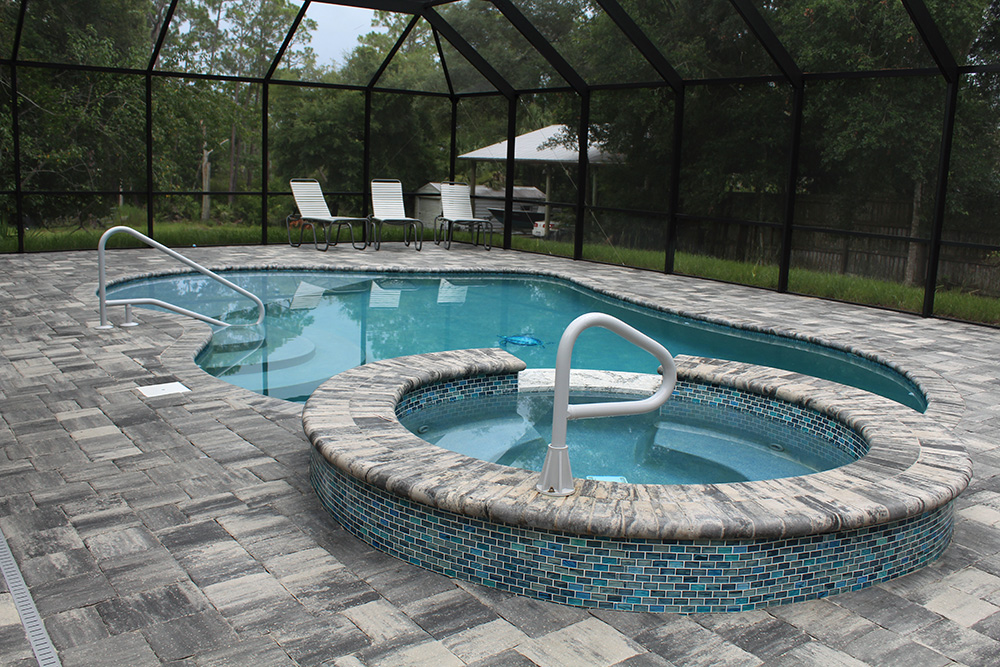
Not every pool in St. Johns County has a screen enclosure, and not every pool needs one. It is one of the more common questions we get during a design consultation, usually somewhere between choosing the pool shape and picking a deck material: do we actually need to screen this in?
A screen enclosure does three things well. It keeps leaves, palmetto bugs, and mosquitoes out of the water, which cuts down on skimming and chemical balancing. On a screened pool, you are typically netting out a handful of leaves after a windy day rather than running the skimmer basket twice and rebalancing chlorine because a season's worth of oak leaves broke down in the water. That translates into fewer filter cleanings and less algae pressure, since decomposing organic debris is one of the main things that throws off water chemistry between service visits.
It also cuts direct sun exposure on the deck, which matters more than people expect once a paver deck or brushed concrete surface has been sitting in Florida sun for a few summers. Sun exposure is what drives paver fading, sealant breakdown, and the surface heat that makes a deck genuinely uncomfortable to walk across barefoot in July. A screen roof does not eliminate UV entirely, but it knocks down the harshest midday exposure and keeps deck surfaces noticeably cooler underfoot, which matters if you have kids or dogs using the pool deck all afternoon.
And it gives you a usable outdoor space during the months when no-see-ums and mosquitoes would otherwise make sitting outside unpleasant in the evening, particularly from late spring through early fall when humidity and standing water in the surrounding area push insect activity up. An enclosure also cuts down on wind-blown debris landing in the water during a storm, and it gives kids and pets a contained space between the house and the pool, which some families value as much as the bug control.
What it does not do is make the space fully climate controlled. A screen enclosure is still an open-air structure. Heat and humidity pass through the screen just as they do outside it, so the space still feels like Florida in August, just without the bugs and with less direct sun. It is comfort and protection, not an extension of the air-conditioned house, and it is worth going into the decision with that expectation set correctly.
Properties near wooded lots or with heavy tree cover tend to get the most value out of an enclosure, since that is where leaf, pollen, and insect pressure is highest. Oak and pine cover in particular sheds year-round in this part of Florida, not just in autumn, so a pool under a tree canopy without a screen tends to need far more frequent cleaning than one out in the open. The same is true for homes close enough to standing water, marsh, or drainage ponds for mosquitoes to be a real evening problem rather than an occasional nuisance. If you already notice bug spray becomes part of the evening routine in your backyard, that is usually a sign an enclosure will get used.
On the other side, some homeowners specifically want an open-air pool deck, either for an unobstructed water view, for a home on a golf course or waterfront lot where the view is the whole point, or because they prefer the look of a pool that reads as part of the landscape rather than sitting behind a structure. An open-air deck also tends to pair better with a resort-style design that leans on lush landscaping and open sightlines rather than a contained outdoor room. Both are reasonable choices, and neither is objectively correct. This is a preference decision as much as a practical one, and we would rather walk you through the tradeoffs, including what you would be giving up either way, than assume you want an enclosure just because most of our projects include one.
Enclosure cost depends mainly on the size of the structure relative to the deck it is covering, the height and roofline, and the screening material chosen. A flat, single-slope enclosure over a modest deck costs less than a domed or two-story design built to clear a taller pool cage or a second-story view. Taller and more architecturally complex rooflines require heavier aluminum framing and more engineering to meet local wind load requirements, and that additional structure shows up directly in the price.
Homes on a corner lot, a pie-shaped lot, or with an irregular pool shape also tend to need more custom framing and more cut screen panels to fit around angles, which adds labor and material to the total compared with a straightforward rectangular enclosure over a rectangular deck. The number and placement of access doors, whether you want a picture-frame no-see-um screen upgrade versus standard screen mesh, and any integrated features like a screened outdoor kitchen bump or a pass-through window all factor in as well. As with the pool itself, we do not give a number without seeing the actual site and the proposed deck layout, since two similarly sized pools on paper can call for very different enclosure structures depending on the yard, the roofline of the house, and local permitting requirements.
Screens need periodic rescreening, typically somewhere in the 10 to 15 year range depending on sun exposure, salt air proximity, and storm activity, since UV breaks down screening material faster here than in most parts of the country. Panels facing full south or west sun tend to go first, so rescreening is often a partial, panel-by-panel job rather than an all-at-once replacement. Between rescreenings, it is worth rinsing screen panels a few times a year to clear pollen and salt residue, since buildup left to sit can degrade the mesh faster and make it harder to see through.
The aluminum frame itself holds up well with basic cleaning, a rinse with a hose and mild soap on the tracks and frame corners a couple of times a year keeps it looking clean and keeps door rollers and latches working smoothly. It is worth checking door hardware and screen door closers periodically too, since those are the components that see the most daily wear. It is a lower-maintenance addition than people sometimes assume relative to a pergola or a fully roofed structure, but it is not maintenance-free, and budgeting for occasional panel repairs after a bad storm is realistic rather than a sign something went wrong with the build.
Do screen enclosures survive Florida storms?
Enclosures are engineered to local wind load codes, but screening is the most vulnerable part in a severe storm. Frames generally hold up well; torn screens after a major storm are common and repairable, and most homeowners treat panel replacement as routine storm-season upkeep rather than a structural failure.
Can a screen enclosure be added after the pool is already built?
Yes. It is easier to plan for during the original build, since the deck and footers can be designed with the enclosure's structural posts in mind from the start, but retrofitting an existing pool deck is a common project for us as well, and most decks can accommodate one with the right engineering.
Does a screen enclosure count toward pool safety requirements?
Screening alone typically does not satisfy Florida's pool barrier code on its own. Locking, self-closing screen doors can be part of a compliant barrier system in some cases, but the requirements depend on your specific property and local code. We can talk through what does and does not count for your specific property during a consultation.
Whether an enclosure fits your project depends on your lot, the tree cover and water nearby, how you plan to use the space day to day, and what tradeoffs matter most to you, whether that is an open view, lower maintenance, or fewer bugs on a summer evening. We are happy to walk the property and talk through it honestly, including telling you if we think you would be better off without one.
Ready to take the first step? Contact us today to schedule your free consultation and we will walk the yard with you before you decide.